




Baccarat has a reputation problem. Somewhere between film franchises and velvet ropes, it picked up an air of exclusivity that scares off curious beginners. The reality is that baccarat rules are simpler than they look – baccarat is closer to a coin flip than a chess match: the house edge is among the lowest in any casino, the player makes one decision per round, and the rules fit on a napkin.
This guide covers how baccarat scoring works, the flow of a hand, the third-card rules, real baccarat odds on every bet, and the common baccarat mistakes that quietly cost beginners money.
Baccarat in 30 Seconds
- Goal: Bet on whichever hand (Player, Banker, or Tie) you think will land closest to 9.
- Card values: 2–9 face value, Ace = 1, 10s and face cards = 0. Only the last digit of the total counts.
- Best bet: Banker – house edge of just 1.06%.
- Worst bet: Tie – house edge of around 14.36%.
- Decisions to make: One. Where to place your chip. The dealer handles the rest.
Baccarat Card Values and Scoring
Cards two through nine are worth exactly what they say. Aces count as one. Tens, jacks, queens, and kings are worth zero. Suits mean nothing.
The one genuine quirk in baccarat rules is that only the last digit of any total counts. A hand of seven and eight adds up to fifteen, but in baccarat that hand is worth five. A four and a six make ten, which becomes zero. The tens digit is dropped, every time, without exception. It feels like it should be more complicated than it is. Once the brain accepts that the rule is simply “ignore everything but the last digit,” the rest of baccarat becomes quite manageable.
The best possible hand is a nine. The second best is an eight. When either side receives a natural eight or nine on the first two cards, the round ends immediately with no further draws.
How to Play Baccarat: The Flow of a Hand
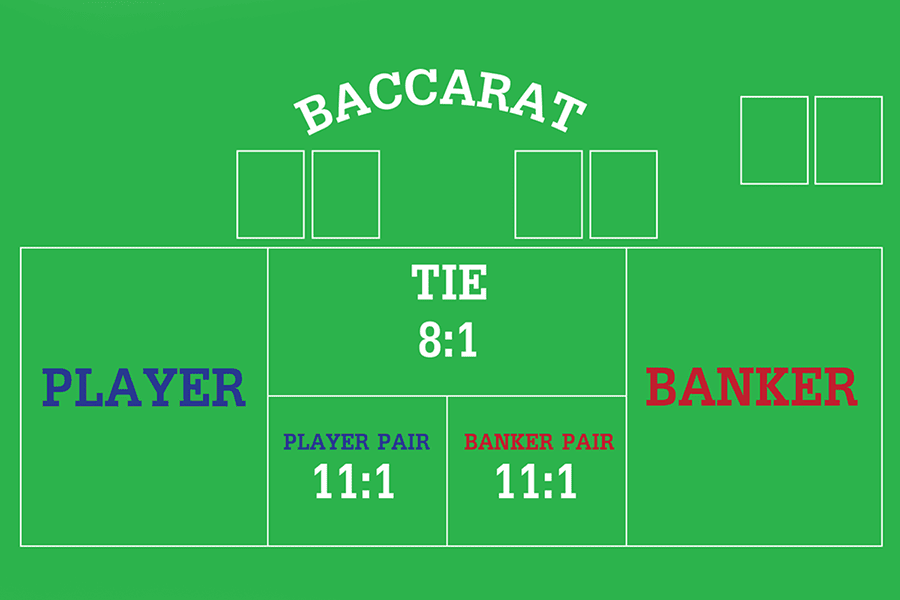
Each round involves two hands dealt face-up: one called Player, one called Banker. Neither name means what it sounds like. The person sitting at the table is not the Player. The Banker is not the casino. They are simply labels – two competing hands that had to be called something.
Before cards are dealt, a bet goes into one of three marked areas on the table: Player, Banker, or Tie. The dealer hands two cards to each side. If either hand totals a natural eight or nine, the round ends. If not, a fixed set of rules determines whether a third card is drawn – and those rules are automatic. The dealer doesn’t decide. You don’t decide. The rules were written down a long time ago, and they still work.
This is part of baccarat’s genuine appeal. There is nothing to learn mid-hand, no decision to agonize over once the bet is placed, and the house edge is lower than almost any other bet on the floor. It’s one of the calmest games in the casino, which is why it has loyal players who never touch blackjack or roulette.
The Third-Card Rules in Baccarat (You Don’t Need to Memorize These)
Here’s the reassuring part: you genuinely do not need to learn the third-card rules to play baccarat. The dealer handles every draw automatically. Most regular players have never memorized the table below. It’s included here for the curious, not as homework.
Player hand rules (simple):
- Total of 0–5 → draw a third card
- Total of 6 or 7 → stand
- Total of 8 or 9 (a natural) → round ends, no draw
Banker hand rules (depends on the Player’s third card):
| Banker’s two-card total | Banker draws if Player’s third card is | Banker stands if Player’s third card is |
|---|---|---|
| 0, 1, 2 | Always draws | Never stands |
| 3 | 0–7, 9 | 8 |
| 4 | 2–7 | 0, 1, 8, 9 |
| 5 | 4–7 | 0–3, 8, 9 |
| 6 | 6 or 7 | 0–5, 8, 9 |
| 7 | Always stands | Never draws |
If the Player stood (totals of 6 or 7), the Banker follows a simpler rule: draw on 0–5, stand on 6 or 7.
That’s it. The table exists for the same reason the safety card in an airplane seat pocket exists – quiet reassurance that someone, somewhere, has thought this through.
Baccarat Odds and House Edge
The Banker bet wins roughly 45.86% of the time. The Player bet wins around 44.62%. Ties account for approximately 9.52% of outcomes. Because the Banker bet wins more often, the casino charges a 5% commission on Banker wins. Even after that commission, the Banker bet carries a house edge of just 1.06% – one of the lowest baccarat odds available at any table game.
| Bet | House edge | Payout |
|---|---|---|
| Banker | 1.06% | 1:1 (minus 5% commission) |
| Player | 1.24% | 1:1 |
| Tie | 14.36% | 8:1 |
The Player bet’s house edge sits at 1.24%. Respectable. The Tie bet pays 8:1 at most tables, sometimes 9:1, and carries a house edge above 14%. The Tie bet exists because a large payout is more emotionally compelling than a small house edge. A meaningful portion of casino baccarat revenue comes from Tie wagers, which tells you something about the distance between knowing the math and acting on it.
For comparison, European single-zero roulette online carries a 2.7% house edge, and most slots sit between 2% and 15%. The 1.06% house edge for the Banker bet in baccarat is lower than online blackjack’s average house edge for players who don’t use optimal strategy – which is most casual players.
Baccarat Rules for Betting
This is the part where baccarat is almost suspiciously simple. You have exactly three choices:
- Banker – best baccarat odds, pays 1:1 minus a 5% commission on wins
- Player – close second, pays 1:1 with no commission
- Tie – long odds, pays 8:1 (more on why to skip this below)
You place your chips. The cards are dealt. You either win or you don’t.
The Banker bet is the statistically best baccarat bet in every single round. The Player bet is close behind. The Tie bet is there because casinos understand human psychology.
One thing worth knowing: if you bet on Banker and win, the 5% commission is typically collected at the end of the shoe rather than deducted from each payout. The dealer keeps a running tally. When the shoe is finished or you leave the table, the commission comes due. This sometimes surprises first-time players, so it’s worth flagging.
No-Commission Baccarat: Is It Actually Better?
Some baccarat tables advertise no commission on Banker wins. This sounds like a concession. It isn’t really.
In no-commission baccarat, the Banker bet pays 1:1 on most winning hands, but when the Banker wins with a total of six, the payout drops to 0.5:1 – meaning you receive half your bet back as profit. The Banker wins with a six roughly 5.4% of the time. Accounting for this adjustment, the house edge on the Banker bet rises to about 1.46%, compared to 1.06% in standard baccarat. The cost didn’t disappear. It moved somewhere less conspicuous.
No-commission baccarat runs faster because the dealer has no commissions to track – a genuine practical advantage at busy tables and online. The format is reasonable if speed is the priority. The trade-off is simply worth knowing about before choosing a table.
Mini-Baccarat and Other Baccarat Variants
Mini-baccarat is what most players encounter on casino floors and online. Same baccarat rules as the full-sized game, fewer seats, faster pace, lower minimums. The dealer handles all cards. At traditional big baccarat tables – the kind that appear in films – players take turns holding the shoe, which adds theater without adding strategy.
Online casinos typically offer several baccarat variants:
- Speed Baccarat moves at roughly 100 hands per hour by cutting dealing time.
- Squeeze Baccarat restores the slow card reveal that high-limit tables are known for.
- Lightning Baccarat introduces random multipliers on certain hands, increasing potential payouts while adjusting the base house edge accordingly.
Live dealer baccarat, available at most online operators including OlyBet’s live casino, places a human dealer with real cards in front of a camera. The experience sits somewhere between the efficiency of a software game and the experience of a physical table.
Common Baccarat Mistakes to Avoid
The most expensive baccarat mistake is betting the Tie. At a 14.36% house edge, you’re paying roughly fourteen times what the Banker bet costs per hand.
- Betting the Tie. The 8:1 payout looks tempting, but you’ll lose this bet far more often than you’ll win it. Long term, it’s the costliest seat at the table.
- Chasing patterns. Most baccarat tables have a scoreboard showing recent results, and plenty of players study it as if it contained a secret. It doesn’t. Previous hands have no effect on future ones. Each hand is dealt from a freshly shuffled shoe.
- Using progressive betting systems. The Martingale (doubling your bet after every loss) and similar systems look logical on paper. The problem is that paper ignores table limits, bankroll size, and the house edge that never goes away. None of these baccarat strategy systems produce a long-term profit. That’s just the math.
- Switching to Player to dodge the commission. Some players move from Banker to Player specifically to skip the 5% commission. It backfires. Banker wins more often – that’s exactly why the commission exists. Avoiding it just trades a small fee for a slightly worse bet overall.
Ready to Try Baccarat?
The whole game comes down to one bet per round and a set of drawing rules you never need to touch. Banker has the lowest house edge. Tie has the highest. That’s genuinely it – the rest is atmosphere.
▶ Play Live Baccarat at OlyBet
Prefer to explore first? OlyBet’s online casino runs everything from roulette and blackjack to slots, and you can also check out poker. Current casino offers are worth a look before your first session.
Play responsibly. Gambling should always be entertainment, not a source of income. Set a budget and a time limit before you start, and never chase losses. If gambling is affecting your life or someone close to you, support is available – visit your local responsible gambling helpline or learn more about our responsible gaming tools.
Baccarat FAQ
Is baccarat a game of skill or luck?
Baccarat is almost entirely a game of luck. Once you place your bet, every draw is determined by fixed rules, so there is no in-hand decision-making and no skill-based baccarat strategy that changes the outcome. The only “skill” is choosing the bet with the best odds – which is always the Banker.
What is the safest bet in baccarat?
The Banker bet is the safest. It wins more often than the Player bet and has the lowest house edge in baccarat at 1.06%, even after the 5% commission.
Why does the Banker bet pay a commission?
Because the Banker hand wins slightly more often than the Player hand, due to the third-card drawing rules. The 5% commission keeps the bet from being mathematically advantageous to players.
Can you count cards in baccarat?
Technically yes, but it’s not worth the effort. Card counting in baccarat produces a tiny edge that requires tracking thousands of hands. Unlike blackjack, it doesn’t translate into meaningful profit.
What does “natural” mean in baccarat?
A natural is a two-card total of 8 or 9. When either side is dealt a natural, the round ends immediately with no third card drawn.
How much money do you need to play baccarat?
Online mini-baccarat and live dealer baccarat tables typically start at €1 per hand. Big baccarat tables in land-based casinos often start much higher. Always play within a budget you’ve set in advance.