




Nobody teaches you the rules of blackjack. You just sort of soak ’em in. Someone plays a few hands at a holiday party, and 20 years later you’re in a casino wondering if you know what you’re doing.
The good news is, blackjack really is easy and welcoming for new players. If played correctly, the house edge is about 0.5% – the most player-friendly of any table game. The bad news is that correct play is a series of specific decisions that most people have never bothered to look up. This guide covers all of them: card values, the flow of a hand, every action, dealer rules, real odds, and silent mistakes that cost beginners money.
Blackjack Card Values and Scoring
Cards 2–10 are worth face value. Face cards are worth 10. An Ace can be 1 or 11, whichever is better for you. Suits don’t matter. It really is as simple as that.
If an Ace counts as 11 without busting the hand, it is called soft. Ace and a 6 is soft 17. You can take another card without any risk, as the Ace can drop to 1 if needed. That flexibility is valuable. The distinction matters because the correct play differs significantly between the two cases.
A natural blackjack is an Ace and any 10-value card dealt as your first two cards. Three cards that happen to add up to 21 are just 21 – they don’t get the special payout.
How to Play Blackjack Step by Step
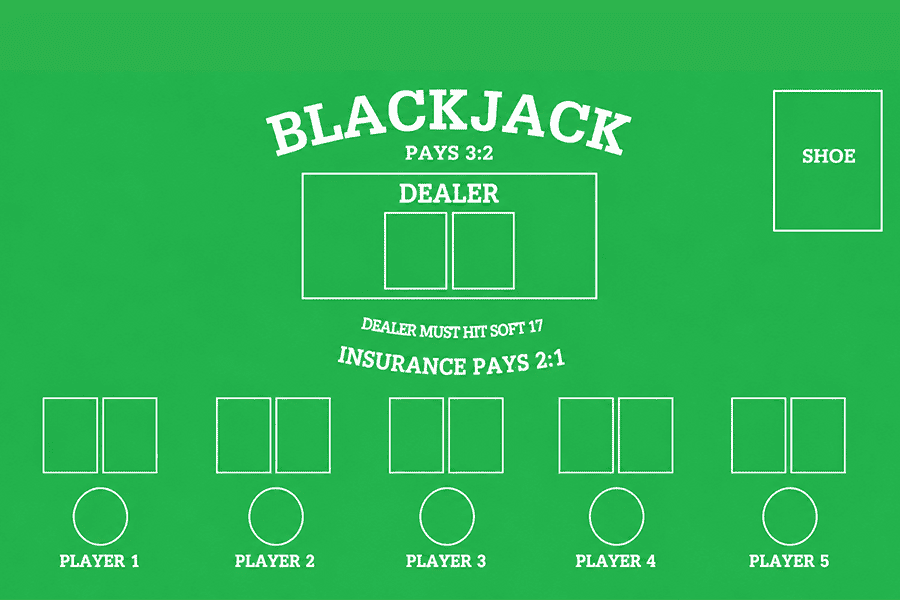
The order is the same each round. Players place their bets. The dealer deals two cards to each player, keeping one face up and one face down (the hole card). In American-style games, the dealer checks the hole card for a natural when the upcard is an Ace or a 10-value card.
Players take turns until they stand or bust. When everyone is done, the dealer flips the hole card and plays according to the rules. Winning hands pay 1:1, a natural blackjack pays 3:2, and pushes return your bet.
Pay attention to that 3:2. Some tables pay only 6:5 on a natural. On a €10 bet, that’s €15 vs. €12 in winnings – a difference that adds 1.39% to the house advantage. Lesson one: always read the felt before you sit down.
Player Actions
Hit means taking another card. Stand means you’re finished. Tap the felt to hit at real tables; wave a flat hand to stand. Casinos want hand signals because the ceiling cameras need evidence you made a choice of your own free will.
Double down means doubling your bet for exactly one more card, after which your turn ends. Some tables allow doubling on any two cards; others only on hard 9, 10, or 11. Doubling on a hard 11 against a weak dealer upcard is one of the strongest positions in the game – ignoring it is one of the most expensive habits a new player can develop.
Split any pair into two separate hands by placing an equal additional bet. Most casinos allow re-splitting up to four hands. Aces are special: when you split Aces, you receive only one more card per Ace. If you split and reach 21, the payout is 1:1, not the 3:2 you’d get from a natural.
Surrender lets you forfeit the hand and recover half your bet. The more common version, late surrender, is available after the dealer checks for blackjack. It’s useful on a hard 16 against a dealer 9, 10, or Ace. Many casinos don’t offer it.
If the dealer shows an Ace, insurance is available – a side bet of up to half your stake that the hole card is a 10-value card, paying 2:1. The dealer actually has a 10 in the hole about 30.9% of the time, giving insurance a house edge of around 7.4%. Even money – the option to take a guaranteed 1:1 when you hold a natural against a dealer Ace – is mathematically identical and just as bad in the long run.
Blackjack Dealer Rules
The dealer follows a fixed script: hit on 16 or less, stand on 17 or more. The one variable is the soft 17 rule. Some tables state “Dealer stands on all 17s” (S17). Others require “Dealer hits soft 17” (H17), forcing a draw on Ace-6. That adds a small but meaningful 0.22% to the house edge.
Blackjack Odds and House Edge
These numbers show the rationale behind basic strategy. Two probability sets account for almost all decisions.
Dealer bust probability by upcard (six decks, S17):
| Dealer upcard | Bust probability |
|---|---|
| 2 | 35.4% |
| 3 | 37.4% |
| 4 | 39.6% |
| 5 | 41.8% |
| 6 | 42.3% |
| 7 | 26.2% |
| 8 | 24.4% |
| 9 | 22.9% |
| 10 / face card | 23.3% |
| Ace | 16.7% |
Cards 4, 5, and 6 are the dealer’s weakest, with bust rates above 40%. Basic strategy recommends standing on 12 through 16 against those upcards and letting the dealer’s forced draws work against them.
Player bust risk when hitting a hard total:
| Your hard total | Bust on next card |
|---|---|
| 11 or less | 0% |
| 12 | 31% |
| 13 | 38% |
| 14 | 46% |
| 15 | 54% |
| 16 | 62% |
| 17 | 69% |
When the dealer shows a 4, 5, or 6, their most likely single outcome is busting. Stand on weak totals like 12 through 16 against those upcards – you don’t need a good hand, you just need to survive the dealer’s bust.
Basic Blackjack Strategy
Basic strategy is the mathematically optimal action for every combination of your hand and the dealer’s upcard. The first version was published in 1956 and has been refined since by computer simulation. It doesn’t give you an edge, but it does reduce the house advantage from about 2% for a casual player to roughly 0.5%.
A few rules cover most situations:
- Always split Aces and 8s.
- Never split 10s or 5s.
- Stand on hard 17 or above.
- Hit hard 8 or below.
- On hard 12 through 16, stand against dealer 2–6 and hit against 7–Ace.
- Double hard 11 against everything except an Ace.
- On soft 17, always hit or double.
- Stand on soft 19 and above.
- Soft 18 stands against weak dealer cards but hits against 9, 10, or Ace.
Printed strategy cards are allowed at every online operator. Nobody will think less of you for using one – and if they do, they’re probably the person splitting 10s.
Common Beginner Mistakes
The most expensive habit is copying the dealer: hit to 17, never double, never split. This gives a house edge of about 5.5% – roughly ten times the cost of correct play. The second biggest leak is taking insurance regularly. Splitting 10s breaks a hand that wins about 85% of the time. Soft 17 is a stand because it’s a total that can’t get worse with one card.
Myths persist. The idea that a bad third-base player ruins the table is mathematically false – over many hands, unconventional plays help as often as they hurt. And RNG blackjack at licensed operators is independently audited by third-party agencies. The “online games are rigged” theory requires you to believe the auditors are in on it.
Blackjack Variants and Side Bets
Atlantic City Blackjack (8 decks, late surrender, S17) is one of the more player-friendly formats at around 0.36% house edge. European Blackjack has a 0.11% higher house edge due to the no-hole-card rule. Spanish 21 eliminates the four 10-spot cards and offers liberal rules. Blackjack Switch lets you swap second cards between two hands but pays 1:1 on naturals.
Live dealer blackjack runs at 60 to 80 hands per hour. RNG software deals 200 or more. Live tables use real cards streamed live and tend to offer side bets like Perfect Pairs and 21+3. House edges on side bets can range from 3% to 11%. All optional.
Ready to Play?
If you’re ready to play blackjack, start with three things: pick 3:2 tables, refuse insurance, and learn the handful of rules that apply to most hands. The house edge drops from around 2% to roughly 0.5%, and the game becomes what it was meant to be – the best odds at any table.
OlyBet’s online casino tables run at low stakes for learning, and the live dealer lounge brings real dealers to your screen. Check the latest casino offers before your first session.